Blog

  • Budgeting as a Behavioral Finance Tool

    For young professionals, budgeting feels like math and sacrifice — but it’s more importantly a tool of behavior. By shaping habits, budgets reduce friction between intention and action, helping you save, invest, and avoid impulse decisions. Early-career investors benefit by allocating small, consistent amounts to diversified investments — a budgeting plan makes that reliable.

    Understand The Psychology. Behavioral finance shows we’re influenced by present bias, loss aversion, and mental accounting. A practical budget uses these tendencies to your advantage:

    Automate Savings and Investing 

    • Set small, measurable goals and public commitment devices to harness social and loss-aversion effects.
    • to bypass temptation and make future-oriented choices automatic.

    Strategic Budgeting Techniques

    • Use rules-of-thumb (50/30/20) or purpose-driven buckets to simplify decisions and reduce decision fatigue.
    • another similar rule its the (70/20/10) Rule, 70% for living expenses (housing, food, transportation).20% for savings or debt repayment. 10% for giving or investing in yourself (charity, courses, skills).
    • 80/20 Rule (Pareto Principle for Money), 80% of financial results come from 20% of actions. Focus on the few money habits—budgeting, debt repayment, investing—that have the biggest long-term impact.
    • 30% Housing Rule, Keep housing costs (rent or mortgage + utilities) under 30% of your gross income to maintain balance for other priorities.
    • 1% Rule of Purchases, For any “want” over $100, wait one full day for every $100 it costs (e.g., wait 3 days before buying a $300 item). This prevents impulse spending.
    • 3-Month Emergency Fund Rule Save at least 3 months of essential expenses in a high-interest savings account (HISA) to cover job loss or emergencies. Work up to 6 months for extra security.

    Track and iterate. Review monthly, adjust categories, and celebrate milestones to reinforce positive behaviors. Treat your budget as an experiment: measure what reduces overspending and increases contributions to an emergency fund and long-term investments. Even modest automatic increases after raises accelerate progress through compounding and habit reinforcement and resilience.

    Closing takeaway: Budgeting is less about restriction and more about designing an environment where good financial behavior happens automatically. Use automation, simple rules, and behavioral nudges to turn intentions into wealth-building habits.

    Russ Adams
  • Smart Money Moves for Two: Top 10 Budgeting Tricks for Couples

    When partners sync financial goals, progress accelerates. This compact guide shares ten practical budgeting tricks to build savings, manage debt, and invest confidently together.

    1. Set shared goals: use a joint vision to prioritize spending.

    2. Track together: review accounts to stay aligned.

    3. Create a hybrid budget: combine joint bills with personal allowances.

    4. Automate savings: allocate automatic transfers for emergency and investment funds.

    5. Split fairly: choose percentage-based contributions to match incomes.

    6. Emergency fund first: aim for 3–6 months of expenses.

    7. Communicate money values: schedule monthly finance check-ins.

    8. Use envelopes or apps: control discretionary spending.

    9. Plan for irregular costs: save for taxes, vacations, and repairs.

    10. Invest as a team: align asset allocation and retirement plans.

    With clear roles and regular communication, couples can reduce friction and accelerate wealth building. Start small, track progress, and prioritize shared investing goals. These techniques support both short-term stability and long-term investing discipline. Use shared dashboards, revisit allocations annually, and consult a financial planner when decisions become complex. Start today, together. Now.

    Created by

    signature

    Lee Adams

  • Behavioral Budgeting: Small Habits, Big Gains

    Budgeting is often framed as numbers and rules, but psychology drives whether a plan succeeds. Recognizing emotional triggers, cognitive biases, and habit loops turns budgeting into a sustainable lifestyle rather than a one-time chore.

    Start by acknowledging that loss aversion, present bias, and mental accounting influence spending. People overweight short-term pleasure and underestimate future costs; to counter this, automate savings and set implementation intentions that make desired actions easier.

    Framing matters: labeling funds as “fun” or “emergency” leverages mental accounts to protect goals. Social cues and accountability—sharing targets with a friend or advisor—increase follow-through. Use small, immediate rewards for hitting milestones to sustain motivation.

    Make budgets flexible. Rigid rules can backfire and cause abandonment; instead, allocate discretionary buffers and review progress monthly. Track behavior not just categories—note triggers and moods to refine strategies.

    Takeaway: By combining simple behavioral tools—automation, framing, social accountability, and adaptive rules—you make budgeting resilient and aligned with long-term investing goals. Regularly reviewing small wins builds confidence; use simple tracking apps or spreadsheets to see progress visually. Remember, budgeting is a skill — experiment, learn, and adjust rather than aiming for perfection overnight. Small habits compound into meaningful financial freedom. Start today now.

    Created by

    signature

    Lee Adams

  • Levels to the game – Personal Finance

    Level 1 – The Financial Basics

    Goal:Cover your basic needs without falling behind, track income, expenses, fixed, or variable costs

    • Learn to track income vs. expenses (know where money goes).
    • Build a bare-bones budget (food, shelter, transportation, essentials).
    • **** Eliminate or reduce high-interest debt (credit cards, payday loans).
    • (SAVING) Create a starter emergency fund ($500–$1,000).

    You’re stable when you can pay bills on time without borrowing.

    Level 2 – Financial Strategies & Stability

    Basic needs covered, fixed and variable expenses are known, you have a basic financial system. 

    Goal: Keeping the good habits and creating new good habits, learn about future you & the usage of different accounts and automation. 

    • (SAVING) Build a full emergency fund (3–6 months of expenses).
    • **** Continue reducing debt (student loans, car loans, etc.).
    • Start automating savings, pay yourself first, save for a rainy day, or pay future you 
    • Open SAVING (HIGH INTEREST) , INVESTMENT (TFSA) or retirement (RRSP) account (RRSP/TFSA in Canada).
    • Understand the basics of credit score and protect it.

    You’re stable when you’re not worried about unexpected expenses.

    Level 3 – Financial Growth

    Goal: Make your money work for you, developing financial strategies, making your money have babies. 

    • Save and invest at least 15–20% of income consistently.
    • Diversify with index funds, ETFs, or real estate.
    • Increase income through career growth, side hustles, or entrepreneurship.
    • Avoid lifestyle inflation (spending more just because you earn more).
    • Learn about taxes and optimize contributions (RRSP, TFSA, RESP if kids).

    You’re growing when your investments start producing passive income.

    In summary, there are level to the game, learning them will save you tones of time in lost or squandered money.

    If you don’t disagree with the article or thing we need to add some, add a comment.

    Created by

    signature

    Lee Adams

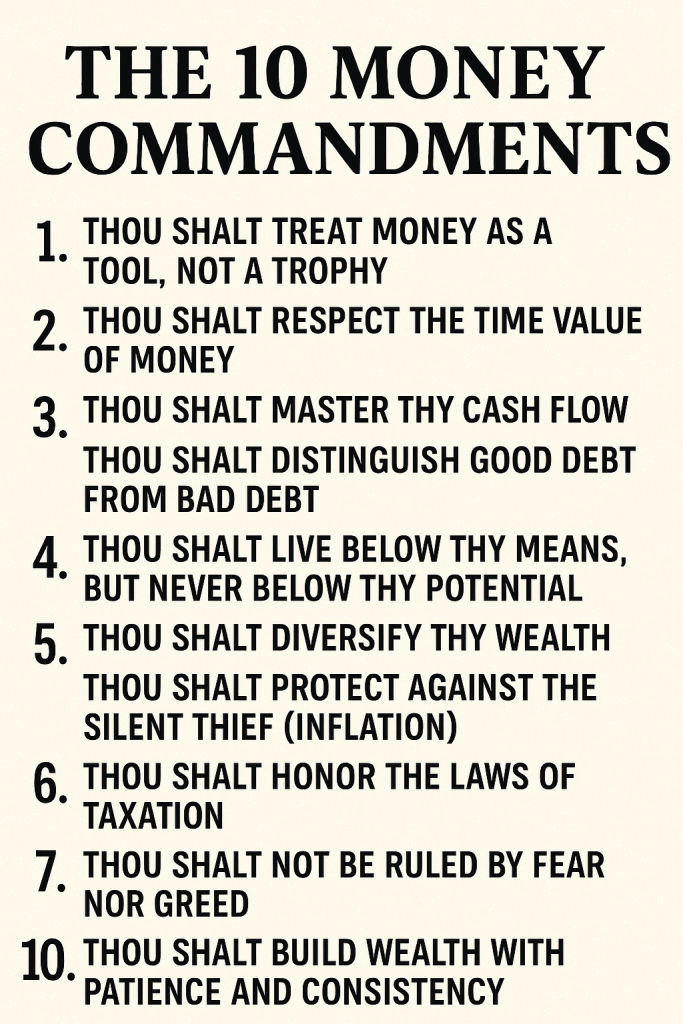
  • IS IT TOO BIBLICAL?

    What did we miss ?Add a comment…

  • Smart Starts: Budgeting & Financial Literacy for Young Professionals

    As a young professional in Canada, building healthy money habits now shapes your financial future. Practical budgeting and basic financial literacy help reduce stress while increasing long-term wealth.

    Start by tracking expenses for a month to understand where money goes. Create a simple budget using the 50/30/20 rule: 50% needs, 30% wants, 20% savings and debt repayment. Build an emergency fund equal to 3–6 months of essential expenses to avoid high-interest debt from credit cards or lines of credit. Prioritize paying down high-interest debts while making minimums on others. Learn investing basics—index funds, diversification, and compound interest—and start early even with small amounts. Automate savings and bill payments to stay consistent and avoid late fees. Use budgeting apps or spreadsheets, and monitor your credit score through free Canadian services like Borrowell or Credit Karma.

    Take advantage of employer-sponsored group RRSPs or defined contribution pension plans if offered. Contribute to a TFSA (Tax-Free Savings Account) for flexible, tax-free growth, and an RRSP (Registered Retirement Savings Plan) for tax-deferred retirement savings. Young professionals may also benefit from the First Home Savings Account (FHSA) to prepare for a home purchase. Continuously improve financial literacy: read reputable Canadian sources, take free courses (such as from the Financial Consumer Agency of Canada), and consider speaking with a fee-only fiduciary advisor before major decisions. Review your plan annually to measure progress.

    Small, consistent actions compound into big outcomes. Begin tracking today, set clear goals, and let automation and education work with you to grow both confidence and net worth in the Canadian system.

  • OWC BLOG

    Investing in the 2025 market to create a nest egg

    Operation War chest, it the creation of wealth via smart investment. Understanding markets is key!!!

  • Strategic Positioning

    Strategic Positioning

    The strategy is designed to build wealth, increase market access, protect capital, protect capital, provide financial knowledge and create generational wealth.

  • Beyond the Obstacle

    Beyond the Obstacle

    Welcome to WordPress! This is a sample post. Edit or delete it to take the first step in your blogging journey. To add more content here, click the small plus icon at the top left corner. There, you will find an existing selection of WordPress blocks and patterns, something to suit your every need for content creation. And don’t forget to check out the List View: click the icon a few spots to the right of the plus icon and you’ll get a tidy, easy-to-view list of the blocks and patterns in your post.

  • Growth Unlocked

    Growth Unlocked

    Welcome to WordPress! This is a sample post. Edit or delete it to take the first step in your blogging journey. To add more content here, click the small plus icon at the top left corner. There, you will find an existing selection of WordPress blocks and patterns, something to suit your every need for content creation. And don’t forget to check out the List View: click the icon a few spots to the right of the plus icon and you’ll get a tidy, easy-to-view list of the blocks and patterns in your post.